Last updated: August 11, 2026
- Gestational diabetes changes how much glucose reaches the fetus.
- This article on how gestational diabetes affects your baby: risks and what doctors watch explains the practical version.
- These checks are meant to see how the baby is tolerating the environment in the womb.
- A newborn blood-sugar risk shows up after birth.
Quick Answer: Gestational diabetes changes how much glucose reaches the fetus; this can alter growth, birth timing, and blood sugar after delivery. Most babies do fine. Still, doctors keep an eye on a few specific problems: bigger-than-expected growth, low blood sugar after birth, and signs that the pregnancy needs closer monitoring.
Key Facts
– Gestational diabetes can change fetal growth and newborn blood sugar.
– Bigger babies are a concern before birth; low blood sugar is a concern after birth.
– Doctors often use home glucose logs, ultrasound growth checks, and sometimes fetal testing.
– Newborn glucose checks are common because low blood sugar can appear after delivery.
– Ask your obstetric clinician or diabetes care professional for your own targets and monitoring plan; the American Diabetes Association and ACOG provide guidance, but your care should be individualized.
Gestational diabetes changes how much glucose reaches the fetus. The ripple can affect growth, birth timing, and blood sugar after delivery. This article on how gestational diabetes affects your baby: risks and what doctors watch explains the practical version. If you’ve been told you have gestational diabetes, talk with your obstetric clinician or diabetes care professional about your own situation, because the risks and monitoring plan depend on your numbers, your pregnancy, and your baby’s growth.
I write about pregnancy health and diabetes care for readers who need the practical version, not the textbook version. Plainly, most babies do well. But doctors still watch closely for a few specific problems, especially excess growth, low blood sugar after birth, and signs that the placenta or baby needs closer attention.
How Gestational Diabetes Affects Your Baby: The Main Risks
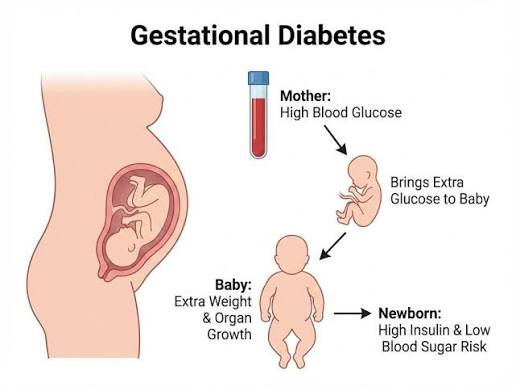
Gestational diabetes affects the baby mostly through the mother’s blood glucose. When maternal glucose runs high, the baby’s pancreas often makes more insulin in response. This extra insulin can change growth patterns and newborn adjustment after delivery. This is the central issue doctors watch for, and it explains most of the baby-focused monitoring.
The most common concern is larger-than-expected growth. Studies and clinical reviews from organizations like the American College of Obstetricians and Gynecologists and the American Diabetes Association suggest that gestational diabetes is associated with a higher chance of a big baby, especially when glucose control is not steady. Delivery can get messy. A larger baby can be harder to deliver vaginally, and shoulder dystocia becomes a concern because the shoulders may get stuck during birth.
A second concern is low blood sugar after birth. While the baby is in the womb, high glucose exposure can push the baby’s insulin production up. After delivery, the glucose supply from the placenta stops abruptly, but the baby may still have extra insulin circulating. That mismatch can drop the baby’s blood sugar, which is why newborn glucose checks are so common in this setting.
Doctors also watch for breathing problems, jaundice, and prematurity-related issues if delivery happens early. These are not unique to gestational diabetes, but the condition can raise the odds of early delivery or lead to a birth plan that comes sooner than expected if the pregnancy is not stable. Early can snowball fast.
There is another risk that gets glossed over in generic articles: growth can go either direction. Some babies exposed to gestational diabetes are larger than expected, but if there are placental problems or other pregnancy complications, growth can be smaller than expected too. That is one reason doctors do not rely on one symptom or one measurement alone.
What Doctors Watch For During Pregnancy
Doctors do not watch just one thing. They look for a pattern: blood sugar control, fetal growth, and signs that the pregnancy is becoming harder on either parent or baby. That broader view matters, because a normal office visit can miss a problem if no one checks the right markers.
The first thing they follow is maternal glucose data. Home glucose logs or continuous glucose monitoring, if used, help show whether meals and timing are keeping levels in range. I’m not giving targets here, because those are individualized and should come from the treating team. The American Diabetes Association advises setting pregnancy glucose goals with a clinician, because the right range depends on the person and the pregnancy.
They also watch ultrasound growth estimates. These are not perfect, but they help estimate whether the baby is growing too quickly, too slowly, or in an unusual pattern. If the baby appears large, the clinician may talk about delivery planning earlier, because a very large fetus can change the risks around labor.
Another thing they monitor is amniotic fluid. Higher-than-normal fluid can happen when the baby is exposed to more glucose, since the baby may urinate more. That can be a clue that the pregnancy deserves closer follow-up. It is not a diagnosis by itself, but it fits into the picture.
Depending on the case, doctors may also do nonstress tests or other fetal surveillance later in pregnancy. These checks are meant to see how the baby is tolerating the environment in the womb. They are usually used when there are extra concerns, not automatically for every person with gestational diabetes.
The part many people miss is that doctors are also watching for delivery timing and delivery difficulty. If the baby is growing quickly or if glucose control is not where the team wants it, the plan for labor may change. That does not mean an automatic C-section. It means the team is balancing the chance of a smoother delivery against the risk of waiting too long.
The Real Difference Between a Big-Baby Risk and a Newborn Blood-Sugar Risk
The big-baby risk and the newborn blood-sugar risk are related, but they are not the same problem. I think this is where many generic articles get muddy.
A big-baby risk happens before birth. It affects pregnancy and delivery. The concern is size, shoulder positioning, and whether labor will be more difficult. The baby may be perfectly fine metabolically at the moment of birth, but the size itself can create mechanical problems.
A newborn blood-sugar risk shows up after birth. It is about the baby’s transition from placental glucose supply to independent feeding. The baby may look normal at first and still develop low blood sugar later, which is why newborn checks continue after delivery even when labor went smoothly.
If you only think about size, you miss the post-birth issue. When glucose is all you focus on, you miss the delivery mechanics. Doctors care about both because they answer different questions: “Can this baby be born safely?” and “Can this baby stabilize well after birth?”
This also changes how doctors counsel parents. When growth is the main issue, they may spend more time on delivery planning. When newborn glucose risk is the main concern, they may focus more on feeding and observation after birth. The same diagnosis can lean in one direction or the other depending on the pregnancy.
Gestational Diabetes: Who Is at Higher Risk for Baby Problems, and Who Isn’t
Gestational diabetes does not affect every pregnancy the same way. It depends on how severe the glucose changes are, whether they are controlled, and whether there are other pregnancy complications in the background.
It matters more when glucose levels are consistently above the desired range, when there is a history of a prior large baby, when ultrasound already shows accelerated growth, or when there are other conditions like hypertension. In those cases, doctors usually watch the fetus more closely because the baby is more likely to show the classic complications.
It is less concerning when the diagnosis is mild, the pregnancy is otherwise straightforward, and glucose patterns are staying close to the care team’s goals. That does not mean “no risk.” It means the risk is lower and the monitoring plan may be lighter.
The honest limitation here is that no one can tell from the diagnosis alone how the baby will be affected. Two people can both have gestational diabetes and have very different pregnancies. One may need extra surveillance and a more complex birth plan. The other may have a normal birth and a healthy newborn with only routine glucose checks.
Who should not assume this will be minor? Anyone who notices reduced fetal movement, worsening blood sugar patterns, a baby measuring ahead on ultrasound, or a clinician raising concern about amniotic fluid or growth. Those are not reasons to panic, but they are reasons to take the follow-up seriously.
The Honest Side-by-Side
Below is the simplest way I can compare the two main baby-related concerns doctors watch for in gestational diabetes.
| Criteria | Big-baby/growth concern | Newborn low-blood-sugar concern | Winner for delivery planning |
|---|---|---|---|
| When it shows up | During pregnancy | After birth | Big-baby/growth concern |
| Main problem | Delivery mechanics and birth injury risk | Transition to life outside the womb | Depends on the stage of pregnancy |
| What doctors measure | Ultrasound growth, abdominal size, fluid patterns | Newborn glucose checks, feeding response, clinical signs | Different tools for different jobs |
| What it can change | Timing and mode of delivery | Observation and feeding plan after delivery | Big-baby/growth concern |
| Who is more likely to have it | Pregnancies with stronger glucose elevation or faster fetal growth | Babies exposed to higher maternal glucose, especially if control was not steady | Neither; risk depends on the pattern |
| Can it be missed without monitoring? | Yes, especially if growth checks are skipped | Yes, because some babies look fine at first | Newborn low-blood-sugar concern |
| How urgent it feels | Usually a planning issue unless delivery is imminent | Can be urgent right after birth if low glucose appears | Newborn low-blood-sugar concern |
| What a generic article gets wrong | It treats size as the only issue | It treats newborn checks as optional | Neither |
The table matters because the same diagnosis can lead to different care decisions. One path is about pregnancy and labor. The other is about the newborn’s first hours. If you blur them together, you miss why the care team keeps watching after delivery even when the birth itself is over.
Our Verdict: Which One to Choose and Why
Choose closer pregnancy surveillance if ultrasound, blood sugar patterns, or your clinician’s exam suggests the baby may be growing too quickly or the pregnancy is becoming harder to predict. Choose newborn glucose monitoring and early feeding support if the main concern is the baby’s adjustment after birth and your pregnancy team expects the birth itself to be otherwise straightforward. Not either one if you are trying to sort this out alone at home; gestational diabetes needs individualized medical follow-up.
That is my clear recommendation because the risks are not interchangeable. Growth concerns change labor planning. Newborn glucose concerns change post-delivery monitoring. A simple summary leaves out the most important part: what stage of the process you are in.
My honest view is that the safest approach is to ask, “What exactly are they watching right now, and what would make the plan change?” That question gets you closer to useful care.
When to Reconsider This Choice Entirely
There are a few situations where the usual “watch and monitor” framing changes.
If blood sugar is not staying controlled despite the current plan, the baby’s risk picture changes. Doctors may tighten surveillance or revisit the delivery plan because the pregnancy is no longer in the low-concern bucket.
If ultrasound suggests the baby is much larger than expected, the conversation shifts from “routine gestational diabetes monitoring” to “delivery planning with birth mechanics in mind.” That is a different problem, and it deserves a different conversation.
If the baby is measuring smaller than expected, that should not be waved away. Gestational diabetes is often linked in people’s minds only with large babies, but growth restriction can matter too, especially if another issue is affecting the placenta.
If you notice reduced fetal movement, bleeding, fluid leakage, or other urgent pregnancy symptoms, stop thinking in terms of gestational diabetes alone and seek prompt medical attention. Those symptoms can signal problems that have nothing to do with glucose and everything to do with whether the pregnancy needs immediate evaluation.
FAQ
Can gestational diabetes harm the baby if my blood sugar is only a little high?
Yes, risk tends to exist on a spectrum. Studies and clinical guidance suggest that steadier glucose control is generally linked with fewer baby-related complications, but the exact impact varies by person and pregnancy.
Do all babies of mothers with gestational diabetes need NICU care?
No. Many do not. Some babies only need a period of observation and glucose checks after birth. Whether extra care is needed depends on the newborn’s blood sugar, feeding, breathing, and overall condition.
Why do doctors keep checking the baby if the pregnancy seemed fine?
Because some problems show up only at the transition after birth. A baby can look well during labor and still have low blood sugar later, especially after exposure to higher maternal glucose.
Does gestational diabetes always mean a bigger baby?
No. It can raise the chance of larger growth, but it does not guarantee it. Baby size depends on glucose control, genetics, and other pregnancy factors.
What should I ask my doctor next?
Ask what they are watching most closely: baby growth, amniotic fluid, fetal testing, delivery timing, or newborn glucose checks. That answer tells you where your actual risk is.